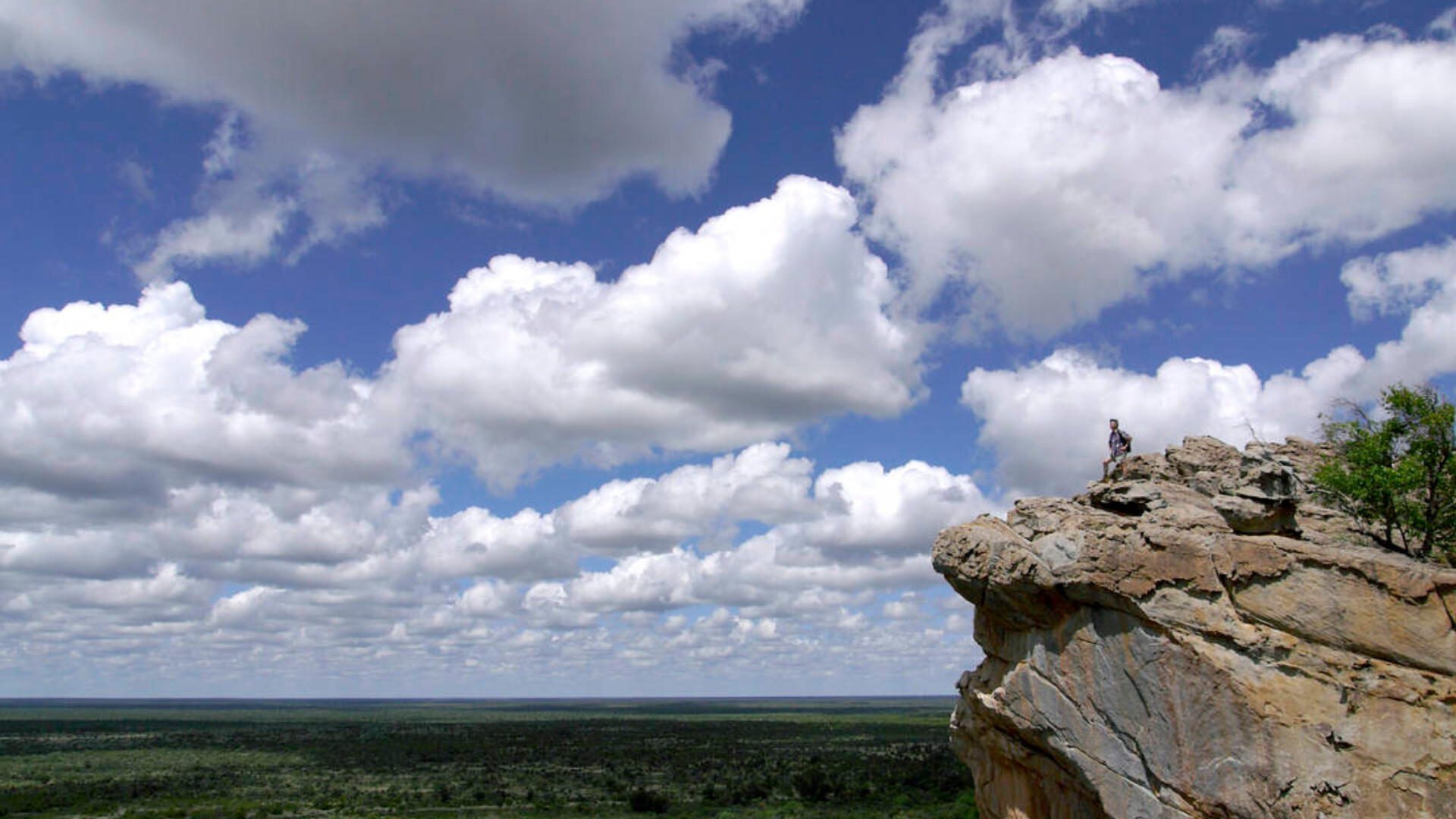
Rising abruptly from the flat expanse of the northwestern Kalahari, the Tsodilo Hills stand like an intrusion into an otherwise level world. From a distance, they appear almost unnatural, a cluster of steep, rocky elevations emerging without warning from the surrounding sand and scrub. This sudden isolation is one of the first physical puzzles associated with Tsodilo. Geologically, the hills do not gradually transition from the surrounding terrain but instead rise sharply, challenging simple explanations of erosion and uplift. Their presence has made Tsodilo one of Southern Africa’s most intriguing and physically enigmatic landscapes.
The Tour Guide told us that Tsodilo Hills consist of four main quartzite ridges, often referred to as the Male, Female, Child, and Grandchild Hills. Quartzite is an exceptionally hard rock, resistant to erosion, which partially explains why the hills have endured while surrounding softer materials wore away. However, this explanation does not fully resolve the mystery of why these formations stand so isolated and intact. The surrounding region shows no comparable structures of similar size, suggesting that a highly localized geological process preserved Tsodilo while everything around it succumbed to erosion. The exact sequence of events that led to this outcome remains a topic of debate among geologists.
Beyond their physical isolation, the hills are associated with unusual acoustic and atmospheric effects. Visitors frequently report strange echo behavior, where sounds seem to return distorted, delayed, or originating from unexpected directions. In some areas, footsteps and voices appear amplified, while in others they seem abruptly swallowed by silence. These effects may be influenced by the steep rock faces, narrow gullies, and the density of quartzite, but their irregularity makes them difficult to predict or replicate under controlled conditions.
Temperature behavior around Tsodilo also appears inconsistent with expectations. During the day, certain rock surfaces heat rapidly, while shaded areas remain unusually cool. At night, some sections retain warmth longer than anticipated, creating microclimates within a relatively small area. While desert environments are known for temperature extremes, the sharp contrast over short distances around the hills suggests complex interactions between rock composition, airflow, and solar exposure that are not yet fully modeled.
The physical mysteries of Tsodilo are deepened by the hills’ extensive rock art, some of the oldest in the world. Thousands of paintings cover cave walls and rock shelters, indicating that humans have been drawn to this landscape for tens of thousands of years. From a physical standpoint, the preservation of this art raises questions. Despite exposure to wind, temperature shifts, and occasional moisture, many paintings remain remarkably intact. The protective qualities of certain rock surfaces and overhangs are understood in general terms, yet Tsodilo’s level of preservation remains exceptional given its age and environment.
Visiting the Tsodilo Hills is a journey into both remoteness and deep time. Located far from major cities, the site requires travel along long stretches of gravel road, reinforcing the sense of isolation that defines the landscape. Access is controlled to protect the hills, and visitors are encouraged to explore with registered local guides who provide both logistical support and contextual understanding. This guided approach ensures safety while also deepening appreciation for the site’s complexity.
Once at Tsodilo, visitors can hike established trails that wind around and between the hills. These trails vary in difficulty, from gentle walks to more demanding climbs that reward effort with sweeping views of the Kalahari. As one moves higher, the surrounding flatness becomes more apparent, emphasizing just how anomalous the hills are within their environment. Standing atop one of the ridges, the vastness of the desert contrasts sharply with the concentrated vertical presence of Tsodilo.
Exploration of the rock art sites is a central part of the visitor experience. Guides lead visitors to selected shelters where paintings depict animals, human figures, and abstract symbols. The physical act of standing in these spaces, often cool and acoustically unusual, adds to the sense that Tsodilo operates under different environmental rules. Sound seems to behave differently within these shelters, amplifying whispers or creating subtle reverberations that enhance the atmosphere.
Photography, birdwatching, and quiet observation are popular activities, but Tsodilo is not a place for hurried tourism. The absence of crowds and modern distractions encourages slow exploration and reflection. Visitors often remark on the sense of heightened awareness they experience, as though the landscape itself demands attention. Whether this is a psychological response to isolation or a reaction to subtle physical factors remains open to interpretation.
Accommodation near Tsodilo is limited and intentionally low-impact, typically consisting of small lodges or campsites that emphasize sustainability. Spending a night near the hills allows visitors to experience dramatic shifts in light and temperature, particularly at sunrise and sunset when the quartzite glows and shadows exaggerate the hills’ shapes. At night, the lack of artificial light reveals an intense star field, reinforcing the feeling of being far removed from the modern world.
Ultimately, the Tsodilo Hills remain mysterious not because science has no answers, but because existing explanations feel incomplete. Their isolated emergence, acoustic oddities, and microclimatic behavior resist simple categorization. For visitors, Tsodilo offers an encounter with a landscape that feels deliberately set apart, a place where physical law seems subtly bent rather than broken. In this quiet corner of Botswana, the hills stand as a reminder that the Earth still holds structures that challenge our understanding, inviting both investigation and humility.
Leave a Reply