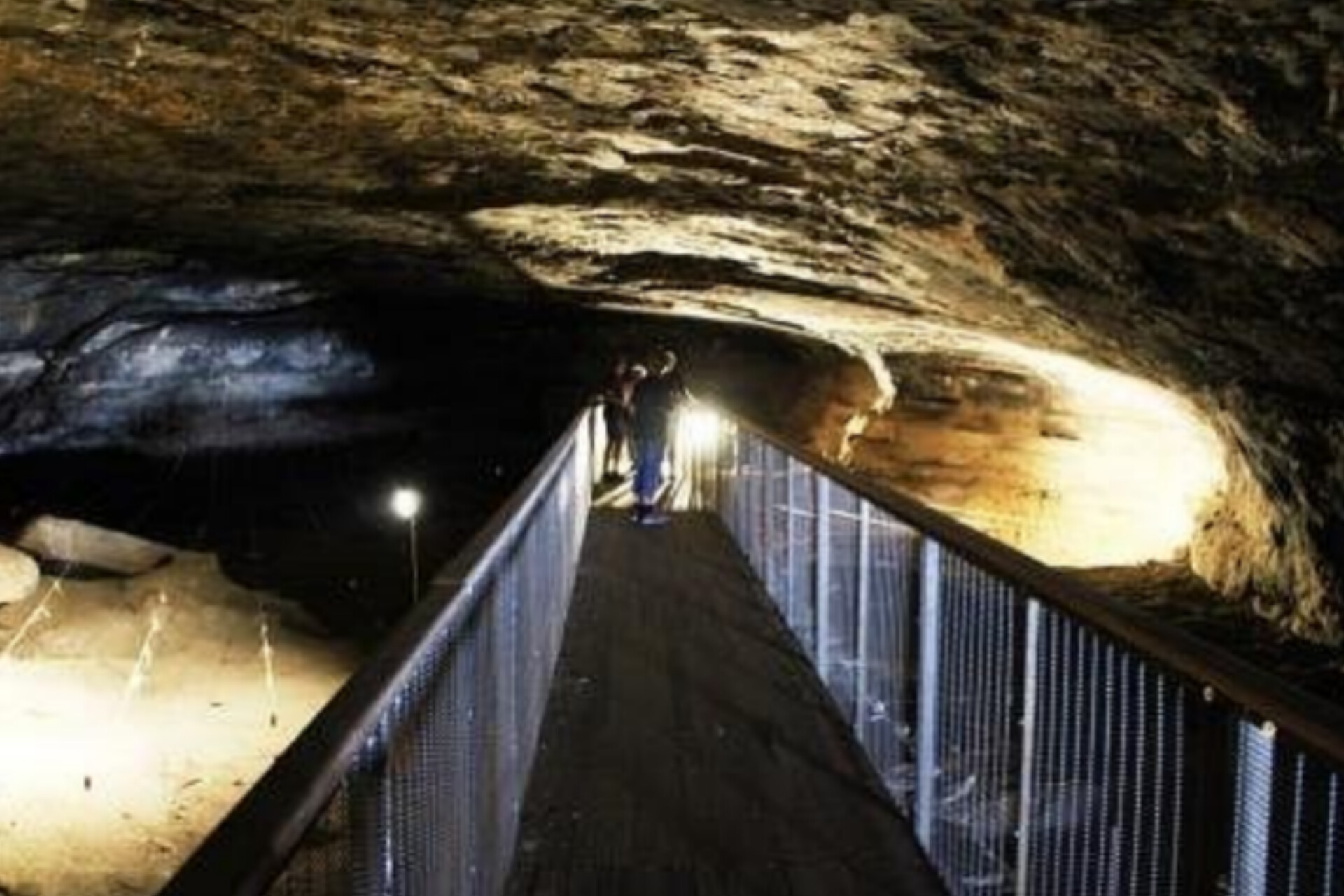
Wonderwerk Cave, located near Kuruman in South Africa’s Northern Cape province, is one of the most extraordinary archaeological sites in the world. Its importance lies not only in its great age but also in the remarkable continuity of human occupation preserved within its vast interior. The name “Wonderwerk,” meaning “miracle” in Afrikaans, is fitting, as the cave provides an almost uninterrupted record of human activity stretching back nearly two million years. Today, Wonderwerk Cave is both a globally significant research site and a fascinating place for visitors to explore, offering a rare opportunity to walk into deep prehistory while enjoying an accessible and engaging heritage experience.
The archaeological value of Wonderwerk Cave is unparalleled. Excavations have revealed evidence of human occupation dating back to the early Stone Age, associated with some of the earliest members of the human lineage. Stone tools found deep inside the cave suggest that early humans deliberately moved far from the cave entrance, challenging earlier assumptions that such deep cave use was rare in early prehistory. This finding alone reshaped archaeological understanding of early human behavior, showing greater adaptability, planning, and spatial awareness than previously believed.
One of the most groundbreaking discoveries at Wonderwerk Cave is the evidence for the controlled use of fire dating back approximately one million years. Layers of ash, burned bone, and heated stone tools were found deep within the cave, far from natural fire sources such as lightning. This strongly suggests that early humans not only encountered fire but also controlled and used it intentionally. The implications of this discovery are profound, as fire use is closely linked to cooking, warmth, protection, and social development. For visitors, learning about this achievement adds a powerful sense of connection to early human ingenuity.
The cave also preserves a long sequence of archaeological layers that document changing technologies and lifestyles over time. Middle Stone Age tools, Later Stone Age artifacts, and even evidence of herding and farming communities appear in higher layers. This continuity allows archaeologists to trace how human societies adapted to environmental changes, developed new technologies, and transformed their ways of life over hundreds of thousands of years. Wonderwerk thus functions as a natural archive, preserving the story of human innovation in a single location.
Modern scientific research at Wonderwerk Cave has involved advanced techniques such as micromorphology, dating methods, and microscopic analysis of sediments. These methods have helped establish accurate timelines and confirm the presence of early fire use. While much of this research happens behind the scenes, its results are shared with the public through interpretive displays and guided explanations, ensuring that visitors benefit from the latest discoveries. This connection between ongoing research and public education makes Wonderwerk a dynamic and evolving heritage site.
For visitors, Wonderwerk Cave is especially appealing because of its accessibility and scale. Unlike many caves that are narrow or difficult to navigate, Wonderwerk features a wide, gently sloping entrance that allows people to walk deep into the cave with relative ease. Guided tours lead visitors through illuminated sections, explaining the archaeological layers and discoveries in a clear and engaging way. Standing inside the cave, surrounded by ancient sediments, visitors gain a tangible sense of time and continuity that few other sites can provide.
The experience of visiting Wonderwerk is both educational and enjoyable. Interpretive signage and explanations help visitors understand how archaeologists read the layers of soil and stone as a record of past human activity. At the same time, the cave’s cool interior and dramatic natural formations create an atmosphere of exploration and wonder. This balance between learning and enjoyment makes the site suitable for families, school groups, and heritage tourists alike.
Economically, the site contributes to local tourism in the Northern Cape, a region often overlooked in favor of more developed tourist areas. By attracting visitors, Wonderwerk supports local employment in guiding, conservation, and hospitality. This demonstrates how even remote archaeological sites can become valuable resources for sustainable development when properly managed and promoted.
The surrounding landscape further enhances the visitor experience. The arid environment of the Northern Cape provides context for understanding how ancient humans adapted to challenging conditions. Visitors can explore nearby attractions, enjoy scenic views, and appreciate the resilience required to survive in such an environment. This broader setting helps situate the archaeological story within a living landscape.
Wonderwerk Cave is a site of exceptional archaeological and human significance. Its nearly two-million-year record of occupation, evidence of early fire use, and continuity of human innovation make it one of the most important prehistoric sites in the world. As a place to visit, it offers a rare combination of accessibility, education, and adventure. By walking into Wonderwerk Cave, visitors do more than observe history; they step into a shared human past that continues to shape who we are today. This makes Wonderwerk not only a place of learning but also a deeply memorable and enjoyable destination.
Leave a Reply