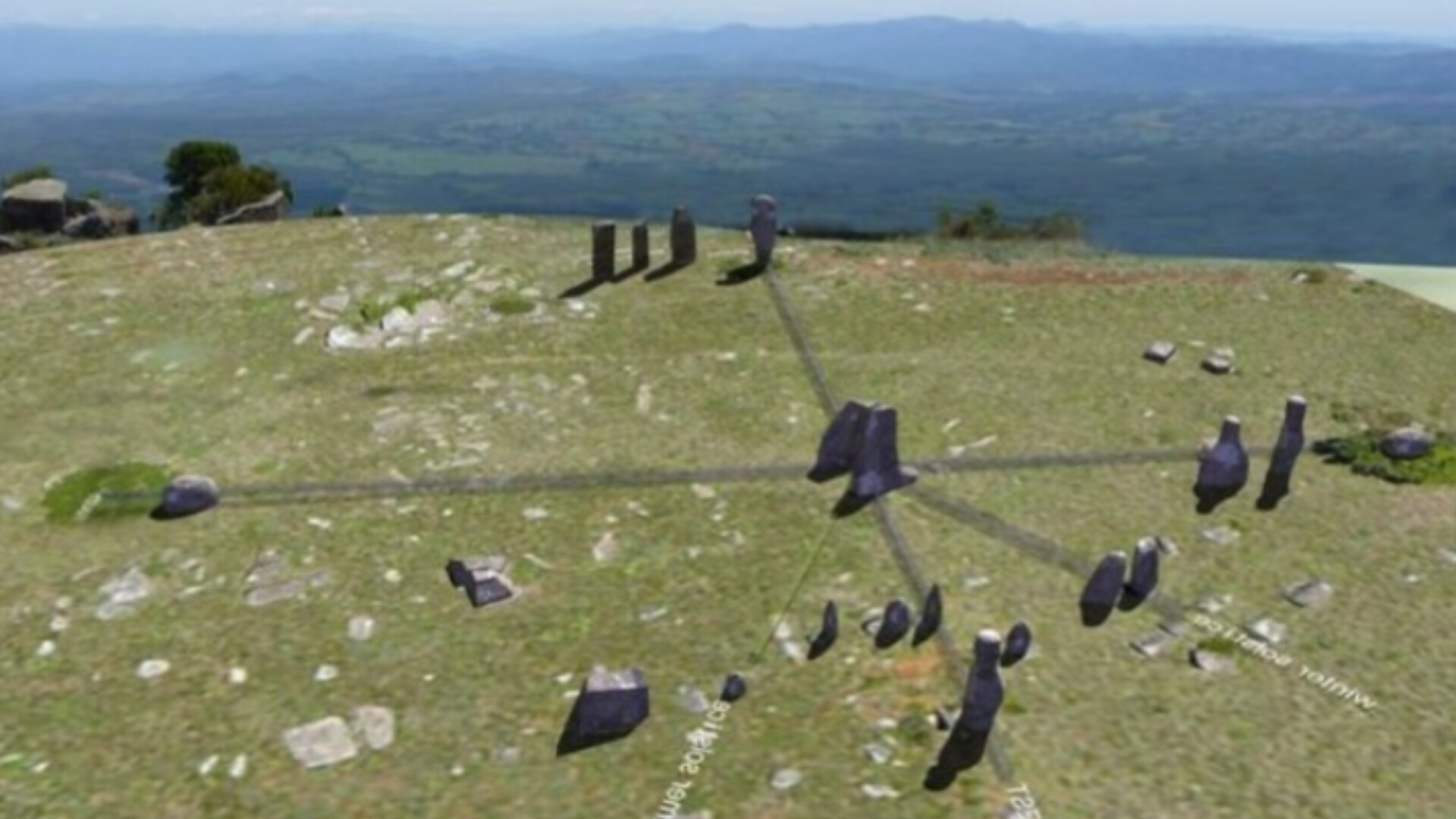
High on a windswept ridge near the small town of Kaapschehoop in Mpumalanga lies one of Southern Africa’s most debated and mysterious ancient sites, commonly known as Adam’s Calendar. To some, it is simply a ring of standing stones scattered across a mountain landscape. To others, it is a profound archaeological anomaly that challenges our perspective with regards to the timelines of human activities on Earth. What makes Adam’s Calendar especially compelling is not only the uncertainty surrounding its origin and purpose, but also the way it blends scientific curiosity, spiritual interpretation, and raw natural beauty into a single, unforgettable destination.
Adam’s Calendar, also known as Enzalo Yelanga, consists of a roughly circular arrangement of large dolerite stones, some standing upright and others fallen, spread across an elevated plateau overlooking the surrounding valleys. The stones themselves are massive, weighing several tons each, and were clearly placed intentionally rather than randomly deposited by natural processes. The circular layout, combined with the positioning of certain stones, has led researchers and independent investigators to argue that the site functioned as an ancient calendar or astronomical observatory. According to these interpretations, specific stones align precisely with sunrise and sunset points during solstices and equinoxes, suggesting a sophisticated understanding of solar movement.
The most controversial aspect of Adam’s Calendar is its proposed age. While mainstream archaeology has yet to formally classify or date the site, some researchers claim it could be tens of thousands of years old, potentially predating known stone structures elsewhere in the world by an astonishing margin. If even a fraction of these claims were accurate, it would force a major reconsideration of early human capabilities in southern Africa. Critics argue that such dates lack peer-reviewed verification, yet no fully accepted alternative explanation has definitively explained the site’s construction, alignment accuracy, or cultural context.
Adding to the mystery is the site’s location within a region known for ancient gold mining. Mpumalanga is home to thousands of stone ruins and mining pits that suggest intensive human activity in deep antiquity. Some theorists propose that Adam’s Calendar may have served as a timekeeping and ceremonial center for early mining communities, allowing them to track seasons, ritual cycles, or agricultural patterns. Others believe it had a spiritual or cosmological function, acting as a place where early humans connected celestial movements with earthly existence. What remains clear is that the stones were not placed casually; their arrangement reflects intention, planning, and knowledge that remains difficult to fully explain.
For travelers interested in visiting Adam’s Calendar, the journey itself is part of the experience. The site is located near Kaapschehoop, a historic town known for its misty weather, wild horses, and bohemian charm. Reaching the calendar typically requires a guided tour, as the site lies on private land and the terrain can be challenging to navigate without local knowledge. Tours usually involve hiking across rocky ground and open grassland, making a reasonable level of fitness important. The remoteness of the location enhances the sense of stepping outside modern time and into a much older, quieter world.
Once at the site, visitors can expect an experience that is both educational and deeply immersive. Guides often explain the various theories surrounding the calendar’s construction, pointing out alignment stones and sightlines used to track the sun. Standing within the stone circle as the wind moves across the plateau, many visitors report a heightened awareness of space and silence. Photography is popular, especially during sunrise and sunset when shadows stretch dramatically across the stones and the surrounding valleys glow with shifting light.
Beyond the calendar itself, the surrounding area offers a range of complementary activities. Kaapschehoop is famous for its wild horses, which roam freely through the town and nearby hills, creating surreal encounters for visitors. Hiking trails wind through forests, waterfalls, and escarpment viewpoints, offering panoramic views of the Lowveld far below. Birdwatching is also a highlight, with species such as the Cape vulture occasionally visible riding thermal currents along the cliffs.
For those interested in reflective or spiritual experiences, Adam’s Calendar often becomes more than a historical site. Many visitors describe a sense of connection, contemplation, or emotional intensity while standing among the stones. Whether this is due to the site’s isolation, its unresolved history, or subtle environmental factors, the emotional impact is undeniable for many who visit. Meditation, quiet reflection, and simply sitting among the stones are common activities, though visitors are generally encouraged to treat the site with respect rather than as a recreational playground.
Accommodation options near Adam’s Calendar range from rustic guesthouses and lodges in Kaapschehoop to more upscale stays closer to Nelspruit (Mbombela). This allows visitors to combine their exploration of the calendar with broader regional attractions, including the Panorama Route and even Kruger National Park, making the trip both intellectually and recreationally rewarding.
Ultimately, Adam’s Calendar remains mysterious not because of what is known, but because of what remains unanswered. Its stones stand as silent witnesses to a past that refuses to fit neatly into established historical frameworks. Whether it is an ancient observatory, a ceremonial center, or something yet to be understood, the site challenges visitors to reconsider assumptions about early human knowledge. For those willing to hike, listen, and reflect, Adam’s Calendar offers not just a visit, but an encounter with one of Southern Africa’s most profound and enduring enigmas.
Leave a Reply